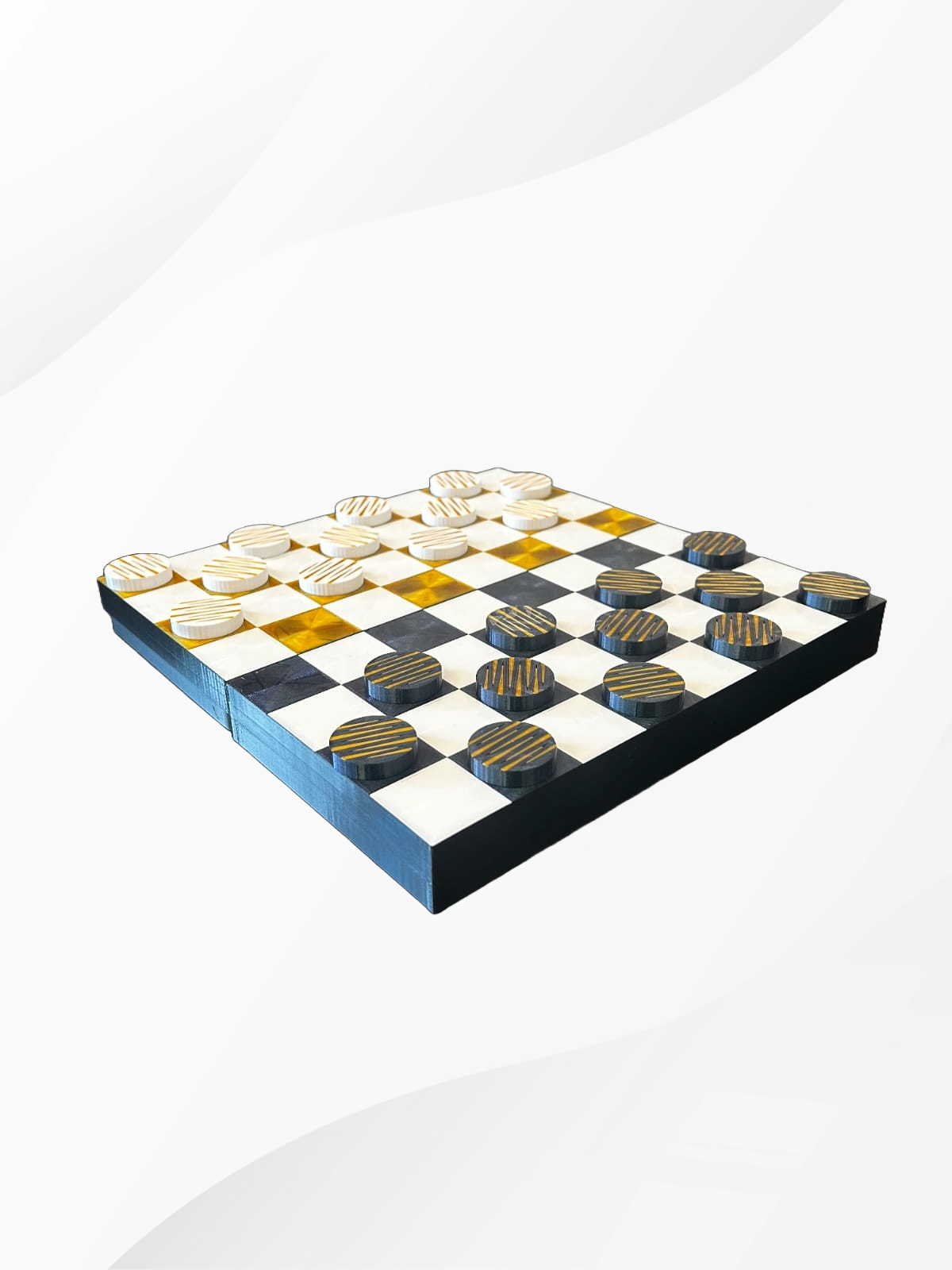
Draughts rules: how to play and set up the board
Draughts, also written drafts and called checkers in the US, takes five minutes to learn. Below you will find how to set up a draughts board, the rules of English draughts on 8 by 8 squares and how international draughts on a 10 by 10 board differs.
How to set up a draughts board
Setting up a draughts board takes 4 steps. This is the standard draughts setup:
- Place the board so that each player has a dark square in the bottom left corner.
- Each player puts 12 pieces on the dark squares of the 3 rows nearest to them.
- The 2 middle rows stay empty.
- The player with the dark pieces moves first.
The dark square in your near left corner is called your single corner; the two dark squares in your near right corner are your double corner. Decide by lot who plays the dark pieces in the first game, then swap colours every game.

Who goes first in draughts?
The player with the dark pieces moves first. In the official rules the pieces are red and white, and many books call them black and white; either way, dark starts. In international draughts on a 10 by 10 board it is the other way round: white moves first.
How many pieces in draughts?
A draughts set has 24 pieces: 12 per player, in two colours. International draughts on a 10 by 10 board uses 40 pieces, 20 per player.
How many squares does a draughts board have?
A draughts board has 64 squares, 8 by 8, and you only play on the 32 dark ones. An international draughts board has 100 squares, 10 by 10, with 50 dark squares.
| English draughts (8 x 8) | International draughts (10 x 10) | |
|---|---|---|
| Squares | 64 | 100 |
| Dark squares | 32 | 50 |
| Pieces per player | 12 | 20 |
| Rows per player at the start | 3 | 4 |
| Empty rows in the middle | 2 | 2 |
| Who starts | Dark | White |
Draughts rules for beginners
These are the rules of English draughts, the game played in the UK on a board of 8 by 8.
- Moving. Taking turns, you move one piece one square diagonally forwards to an empty dark square.
- Capturing is compulsory. If an opponent piece is diagonally next to yours and the square behind it is empty, you must jump over it and take it off the board.
- Men capture forwards only. An ordinary piece, called a man, moves and captures forwards only.
- Multiple jumps. If you can jump again after a capture, you carry on in the same turn.
- Free choice. If you can capture in more than one way, you choose which capture to make, but you must complete every jump of the sequence you chose.
- Crowning. When a man reaches the far row it becomes a king: put a captured piece of your own colour on top of it. If this happens during a capture, the turn ends there.
- Kings. A king moves one square diagonally, forwards or backwards, and captures forwards or backwards as well.
- Winning. You win when your opponent has no pieces left or cannot make a move.
How do you get a king in draughts?
Move a man all the way to the far row, called the king row. It becomes a king straight away and your turn ends there, even if it could jump again. To crown it, put a second piece of the same colour on top, normally one that has already been captured.
Can a king move backwards in draughts?
Yes. A king moves forwards and backwards, one square at a time, and it can also capture in both directions. Ordinary pieces only move and capture forwards.
Do you have to take a piece in draughts?
Yes. Capturing is compulsory. If you have a choice of captures you may pick any of them, as long as you complete every jump of that capture.
Can you jump the same piece twice?
No. In a multiple jump each piece can only be jumped once, and you only ever jump over your opponent's pieces, never your own. The captured pieces come off the board when the whole sequence is finished.
What happens if you miss a capture?
Then you have made an illegal move and it is taken back: you make the capture instead. Once your opponent has made their next move, the position stands. Under the official rules a second illegal move in the same game loses the game. Huffing, where your opponent removed the piece that should have jumped, is not part of the official rules; if you want to play with it at home, agree on it before the game.
Do you have to move a piece you touch?
Yes. If it is your turn and you touch a piece, you must play that piece. If you only want to straighten a piece on its square, say so first.
How do you win at draughts?
You win when your opponent has no pieces left, when it is their turn and all their pieces are blocked, or when they resign.
When is a game of draughts a draw?
When you both agree to it. Under the official rules it is also a draw when a player can show that their next move would bring the same position on the board for the third time, or when for 40 moves each no piece has been captured and neither player has moved an uncrowned man towards the king row.
Tips for your first games
- Look at what your opponent must take. Capturing is compulsory for both of you. If you offer a piece and that is their only capture, you know exactly where their piece will land.
- Keep your back row. An opponent's man only becomes a king on an empty square of your back row, so your own pieces there stop it.
- Get a king. Men only move forwards; a king can also move and capture backwards.
Draughts or checkers: what is the difference?
There is none: draughts and checkers are the same game. In the UK it is called draughts, sometimes written drafts, and in the US checkers. Both are played on a board of 8 by 8 with 12 pieces each.
International draughts on a 10 by 10 board
Clubs and the Dutch draughts competition play international draughts on a board of 10 by 10 squares, with 20 pieces per player on 4 rows. The international rules can also be played on 8 by 8; that version is known as Brazilian draughts. The main differences with English draughts:
| Rule | English draughts (8 x 8) | International draughts (10 x 10) |
|---|---|---|
| Who starts | Dark | White |
| Men capture backwards | No | Yes |
| Capturing the most pieces is compulsory | No, free choice | Yes |
| Kings move | One square | Any distance along the diagonal |
| Crowning during a capture | Yes, and the turn ends | Only if the man ends its move on the far row |
What is the difference between a draughts board and a chess board?
On 8 by 8 there is none: a draughts board and a chess board both have 64 squares. The difference is in the pieces and the rules. In draughts you only use the dark squares and all pieces are the same; in chess every square is used and each player has 16 pieces of 6 kinds. You place both boards the same way: with a dark square in your near left corner, which puts a light square in your near right corner. How to set up the 32 chess pieces is explained in our chess board set up guide.
Can you play draughts on a chess board?
Yes. A chess board has 8 by 8 squares, the same as the board for English draughts. With 12 pieces each on the dark squares you can play draughts on it.
Getting a draughts board of your own
We print a luxury draughts board of 8 by 8 with 24 pieces in two colours, and in the same series a chess board with 32 pieces. Both are in our draughts and chess boards.