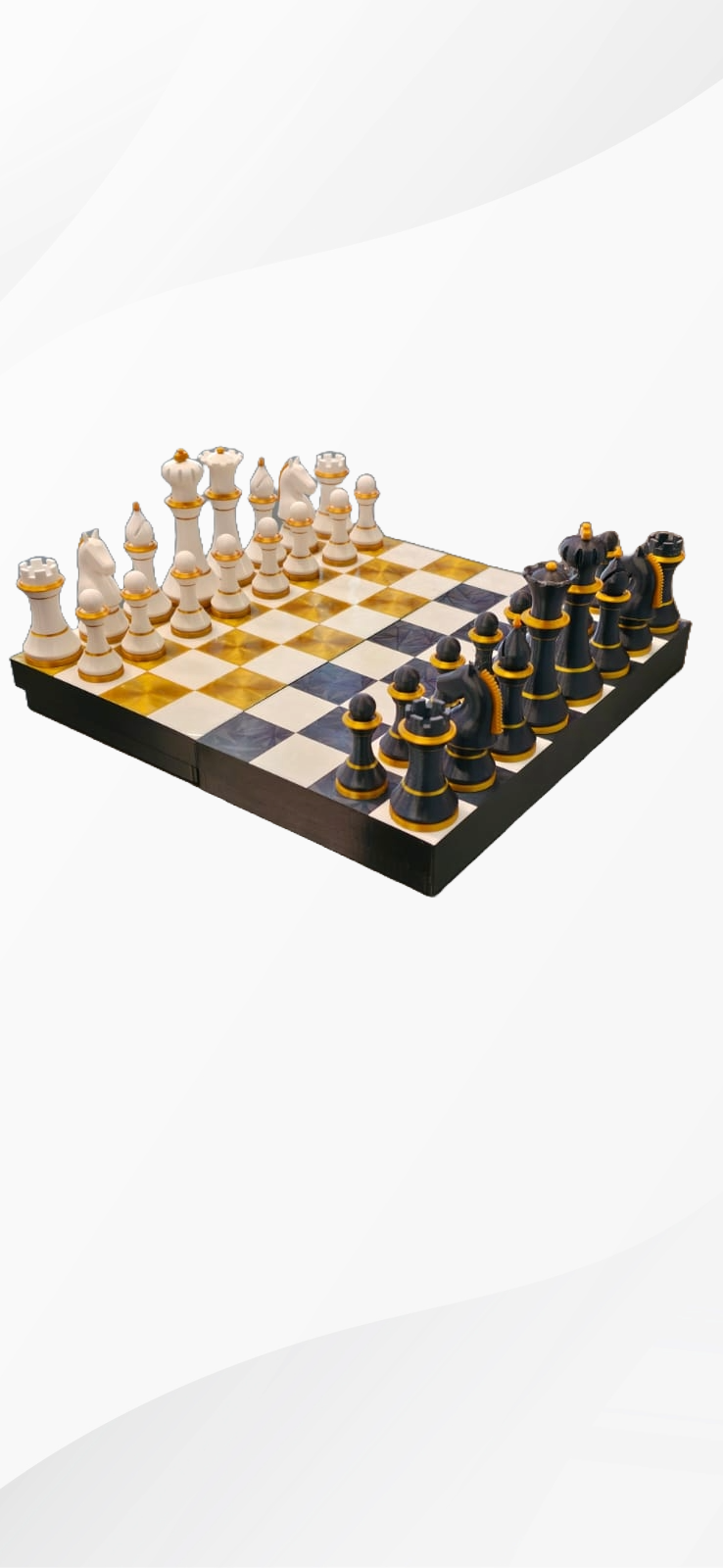
Chess rules: how to set up a chess board and play
This is how to set up a chess board and play: which way the board goes, where every piece starts, how each piece moves and when it is checkmate. A chess board has 64 squares and you play with 32 pieces, 16 each.
How many squares on a chess board?
A chess board has 64 squares: 8 rows of 8. Half are light and half are dark, so 32 light and 32 dark squares. Unlike draughts, you play on every square.
| Squares | 64 |
|---|---|
| Light squares | 32 |
| Dark squares | 32 |
| Files (columns) | 8, a to h |
| Ranks (rows) | 8, 1 to 8 |
| Pieces per player | 16 |
| Pieces in total | 32 |
| Kinds of pieces | 6 |
Which way does a chess board go?
With a light square in the bottom right corner, for both players. If there is a dark square in your bottom right corner, turn the board a quarter turn. If it is right for you, it is right for your opponent too.
How are the squares on a chess board named?
Every square has a name made of a letter and a number. The files are a to h, from left to right as seen from White. The ranks are 1 to 8, starting from White's side. White's bottom left square is a1 and the top right square is h8. This is how you write down a game, as explained in our guide to chess notation.
How many squares are there in total?
If you only count the single squares, there are 64. If you count every square of every size, from 1 by 1 up to 8 by 8, there are 204: 64 + 49 + 36 + 25 + 16 + 9 + 4 + 1.
How many pieces in chess?
A chess set has 32 pieces: 16 white and 16 black. Each player has 1 king, 1 queen, 2 rooks, 2 bishops, 2 knights and 8 pawns. White plays with the light pieces, Black with the dark ones.
| Piece | Per player | Letter | How it moves |
|---|---|---|---|
| King | 1 | K | 1 square in any direction |
| Queen | 1 | Q | Straight and diagonally, as far as the squares are free |
| Rook | 2 | R | Straight, as far as the squares are free |
| Bishop | 2 | B | Diagonally, as far as the squares are free |
| Knight | 2 | N | In an L shape, jumps over pieces |
| Pawn | 8 | no letter | 1 square forward, captures diagonally forward |
How to set up a chess board
Setting up a chess board takes 7 steps:
- Place the board with a light square in your bottom right corner.
- Put your 8 pawns on the second row in front of you: White on rank 2, Black on rank 7.
- Put the 2 rooks in the corners of the row nearest to you: White on rank 1, Black on rank 8.
- Put the 2 knights next to the rooks.
- Put the 2 bishops next to the knights.
- Put the queen on the middle square of her own colour: the white queen on the light square d1, the black queen on the dark square d8.
- Put the king on the last empty square, next to the queen: White on e1, Black on e8.
Black stands exactly opposite White: queen facing queen, king facing king.

Where does the queen go in chess?
On her own colour. The white queen starts on a light square (d1), the black queen on a dark square (d8). An easy way to remember it: the queen goes on her own colour.
Where does the king go in chess?
Next to the queen, on the last empty square of the back row: e1 for White, e8 for Black. That puts the white king on a dark square and the black king on a light square.
Who goes first in chess?
White makes the first move. After that you take turns. Agree before the game who plays White.
How do chess pieces move?
You take turns moving 1 piece. You may not move to a square with one of your own pieces on it. If you move to a square with one of your opponent's pieces on it, you capture that piece and take it off the board.
- King. 1 square in any direction, straight or diagonal.
- Queen. Straight and diagonally, along the whole file, rank or diagonal, as long as nothing is in the way.
- Rook. Straight forwards, backwards or sideways, as far as the squares are free.
- Bishop. Only diagonally, as far as the squares are free. That is why a bishop always stays on the same colour.
- Knight. In an L shape: 2 squares straight and then 1 to the side. The knight jumps over other pieces.
- Pawn. 1 square straight forward, to an empty square. On its first move a pawn may also go 2 squares forward. A pawn captures 1 square diagonally forward.
Can a knight jump over pieces?
Yes. In a normal move the knight is the only piece that can, over your own pieces and your opponent's. It only captures the piece on the square where it lands. The queen, rook and bishop cannot move over other pieces.
Can a pawn move backwards?
No. A pawn only moves forward, also when it captures.
Castling, en passant and promotion
How does castling work?
When you castle, you move your king and one rook in the same turn. The king moves 2 squares towards the rook, and the rook jumps over the king to the square next to it. With the rook on the king's side this is called castling kingside (0-0), with the rook on the queen's side castling queenside (0-0-0).
You can no longer castle once the king or that rook has moved. You cannot castle for the moment if your king is in check, if it would pass over or land on a square your opponent attacks, or if there is a piece between the king and the rook.
What is en passant?
If your opponent's pawn moves 2 squares forward on its first move and lands next to your pawn, your pawn may capture it as if it had moved only 1 square. You can only do this on your very next move.
What happens when a pawn reaches the other side?
When your pawn reaches the last rank, you replace it in the same move with a queen, rook, bishop or knight of your own colour. This is called promotion. Your choice does not depend on which pieces have been captured, so you can have a second queen.
Check, checkmate and stalemate
If one of your pieces attacks your opponent's king, that king is in check. Your opponent must deal with it straight away: move the king, capture the attacking piece or put a piece in between. A move that puts or leaves your own king in check is not allowed.
If your opponent cannot get out of check in any way, it is checkmate and you have won. So the king is never actually captured. A player who resigns loses as well. How to deliver mate quickly is shown in fool's mate, scholar's mate and other quick checkmates.
What is the difference between checkmate and stalemate?
In checkmate the king is in check and there is no way out. In stalemate the king is not in check, but the player whose turn it is cannot make any legal move. Stalemate is a draw.
When is a chess game a draw?
- You both agree to it, after each player has made at least 1 move.
- Stalemate: the player to move has no legal move and is not in check.
- Neither player can checkmate any more, for example when only the 2 kings are left.
- The same position appears for the third time with the same player to move: then you can claim a draw. The fifth time it is a draw automatically.
- For 50 moves by each player no pawn has moved and nothing has been captured: then you can claim a draw. After 75 moves it is a draw automatically.
At home you can agree together which of these rules you use.
Can you play chess on a draughts board?
Only on a small draughts board of 8 by 8: like a chess board, it has 64 squares. An international draughts board has 10 by 10 squares, and the chess set up does not fit on it. The full difference between a draughts board and a chess board is explained with our draughts rules.
Getting a chess board of your own
We print a luxury chess board with 32 pieces: 16 light and 16 dark pieces with a gold coloured ring on the base, on an 8 by 8 playing surface in two halves that fit together. The same series also has a luxury draughts board with pieces. You will find both among our draughts and chess boards.